









EUROCENTRIC

04 · 800–146 BC

Greece and the Citizen

The polis made public rule the work of citizens, then forced rival cities to defend, command and judge that freedom.

Enter the public ground

Act I · Public rule · c. 800–550 BC

The City Steps into the Light

Communities without palaces place law, office and collective identity where a public can see and remember them.

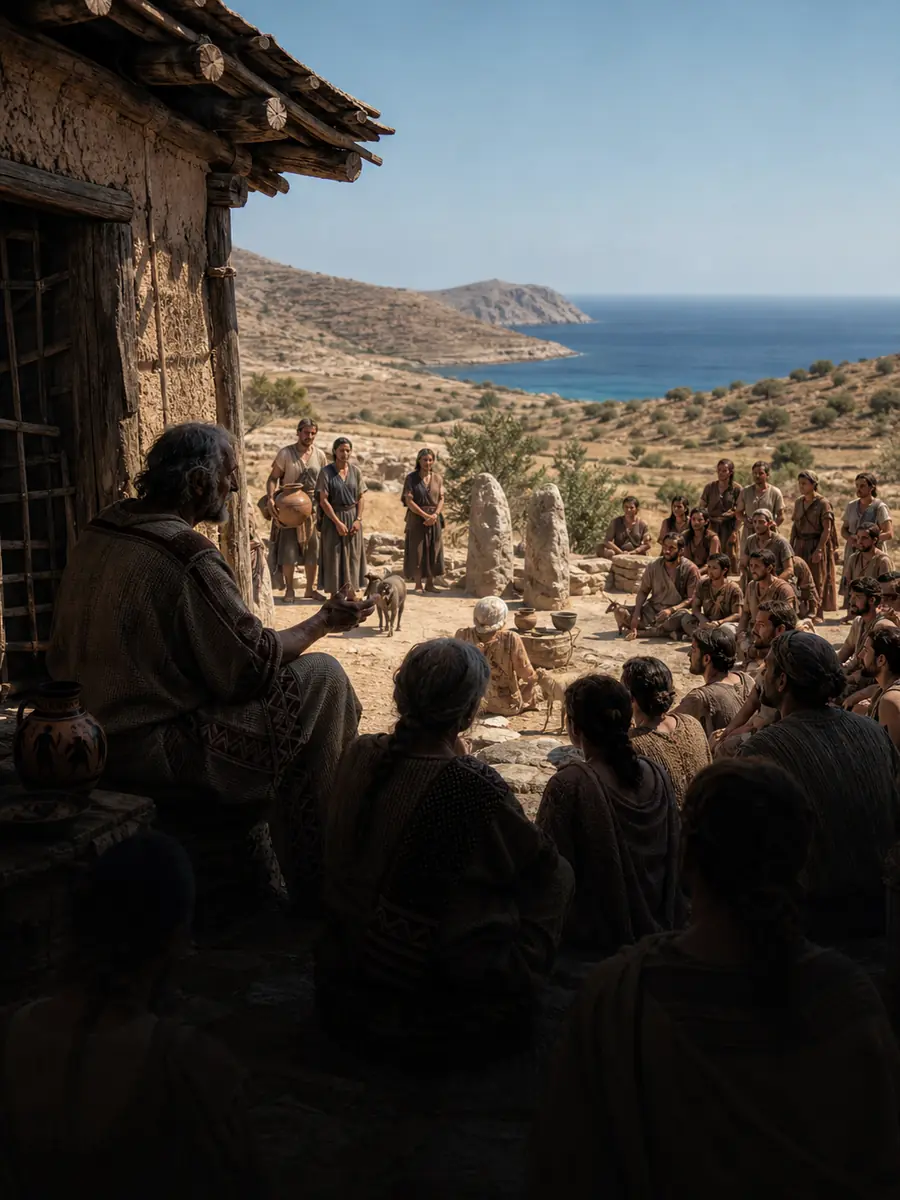
An early Greek singer leaves a firelit hall as families gather in a sunlit sanctuary court without a palace.Place, date and surviving record

c. 800–700 BCEuboea · Attica · the Greek mainland

After the Palace

When no palace returned, Greek communities had to make authority local and visible.

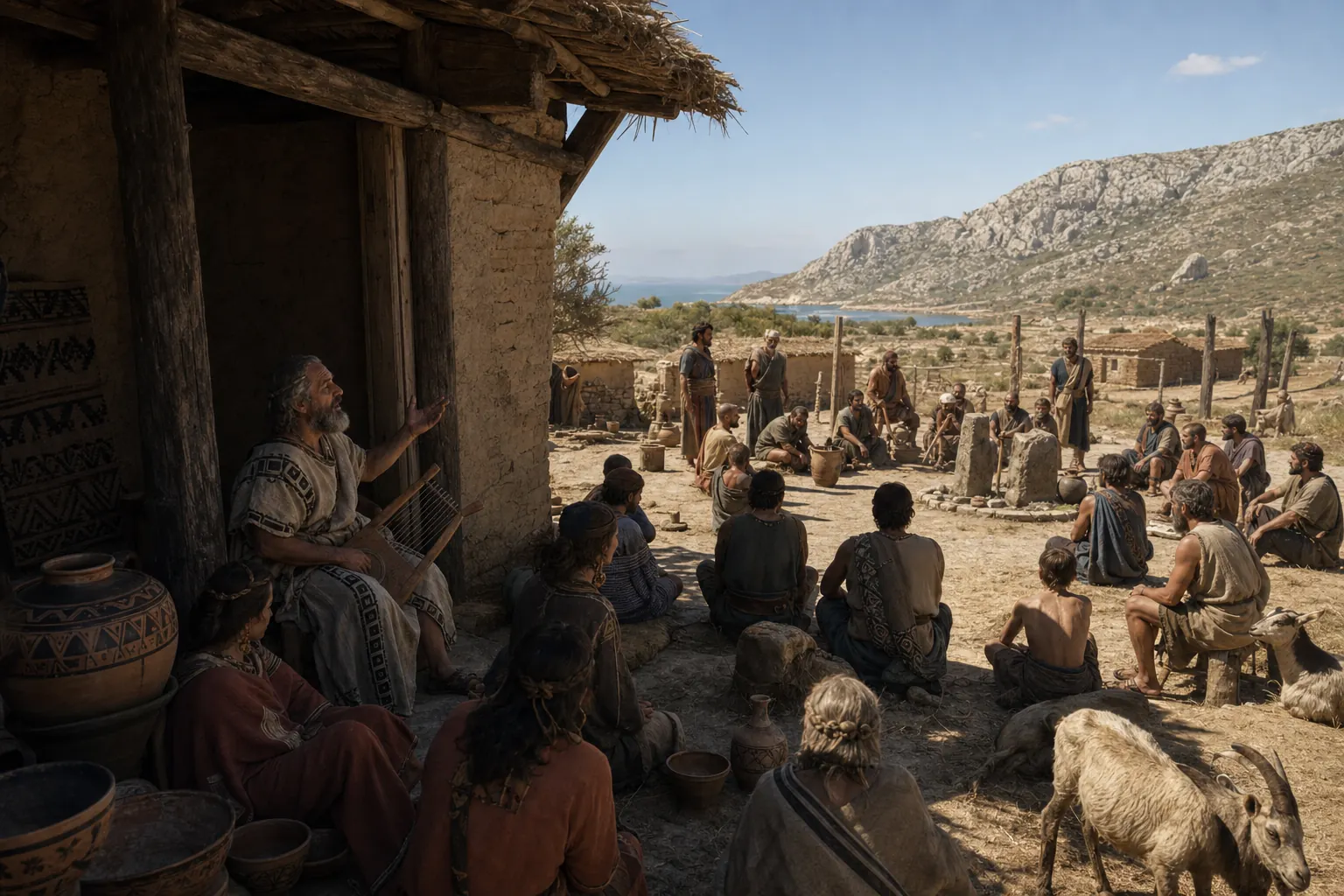
A singer finishes a tale of kings beside a household fire. Outside, the settlement has no throne room, archive or official able to command the whole country. The Mycenaean palaces have been gone for centuries. Their Greek language survived, and their heroes acquired longer lives in song, while the collectors who once counted bronze and grain disappeared. Families, local leaders and sanctuaries now hold pieces of authority that no single institution owns.

People meet because worship, defence, land and judgment cannot remain household matters. An aristocrat may lead an army or settle a quarrel, yet he acts among other powerful families and before a community that expects to hear the result. Councils gather experienced men. Assemblies approve, reject or acclaim. Sanctuaries receive dedications from groups learning to name themselves as one people. The city begins as repeated public action before it acquires monumental stone.

The early offices retain the language and dignity of kingship without restoring a palace king. Several men can bear royal or priestly titles, while authority shifts with circumstance: one leads a raid, another judges, another speaks for a cult. Competition among them needs witnesses. Prestige still matters, but the public gathering becomes the place where prestige must work.

This arrangement creates a problem the palace had solved by command. A decision spoken in one gathering can be denied in the next. A magistrate can claim that custom favours his household. Memory belongs to people who may disagree. Greek communities answer by placing rules in shared places and attaching office to stated limits. The singer preserves a heroic past; the public inscription will make power answer to words that remain after the speaker leaves.

What survived
  • Settlement patterns, sanctuaries, burials and assembly scenes in early poetry preserve communities organised without restored palace administration.
  • The Homeric poems contain memories of the Bronze Age alongside institutions formed during centuries of oral transmission.

Paul Cartledge (2009)Mogens Herman Hansen and Thomas Heine Nielsen, eds. (2004)G. S. Kirk (1961)
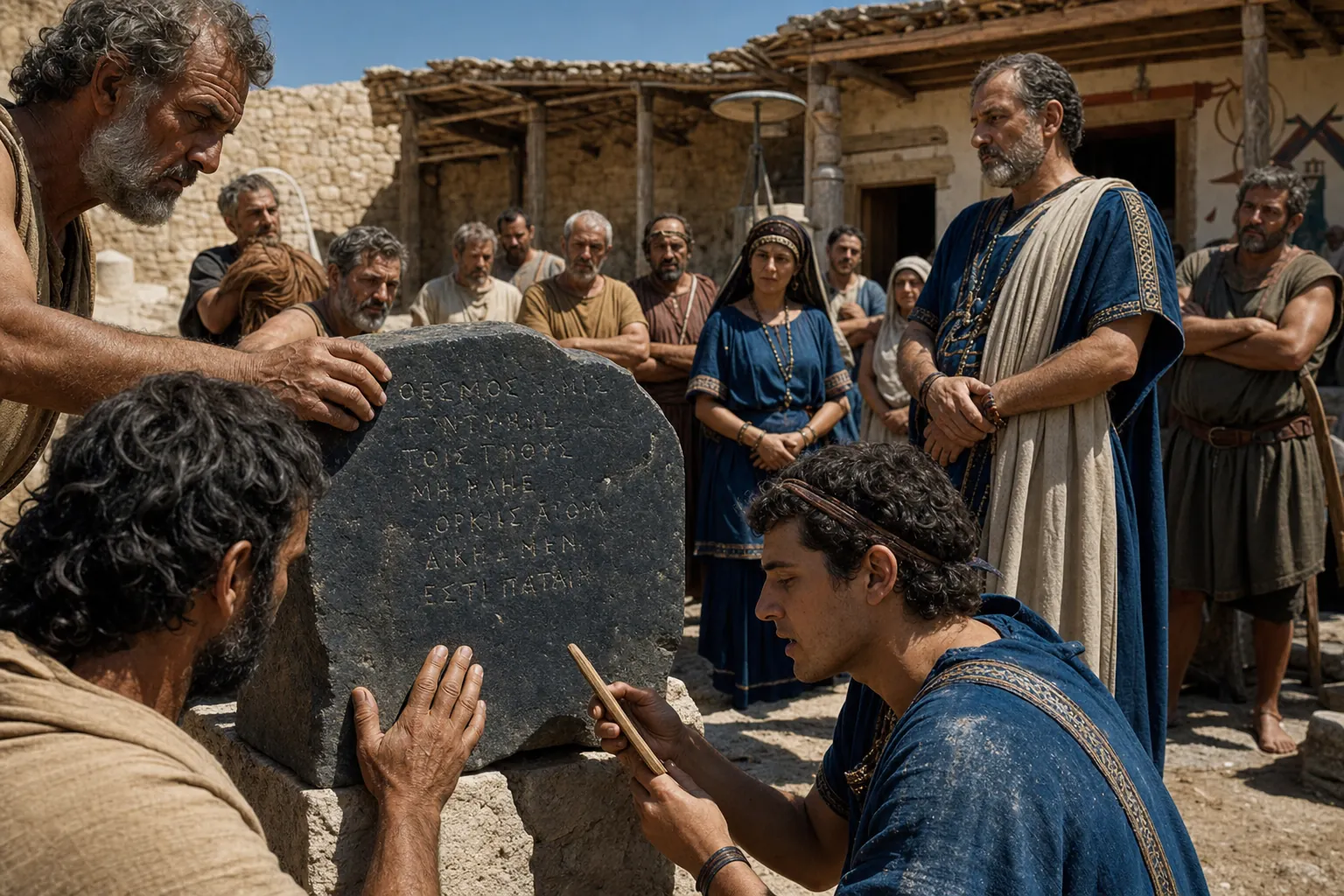
Hands trace an archaic Greek law cut into a dark stone block within a crowded sanctuary.Place, date and surviving record

c. 650–500 BCDreros · Gortyn · Athens

The Law Stands Where All Can See

Writing gave a community evidence that could outlast the official it restrained.

At Dreros on Crete, a stone carries a rule directed at the city’s chief magistrate. A man who has held the office must wait ten years before holding it again. If he ignores the limit, the text names a penalty. The surviving words are brief and damaged, but their position changes political memory. The official no longer keeps the rule inside his household or authority. Other people can point to an object that remains when his term ends.

Public writing does not require every passer-by to read silently. A literate person can sound the words before a gathering; citizens can remember where the rule stands and invoke it during a dispute. Later inscriptions at Gortyn cover a wall with procedures for family, property and status. At Athens, homicide law and reforms attributed to Solon become part of a civic argument about whose rule counts and how it can be recovered.

Material and procedure support each other. Letters cut deeply into stone resist alteration; placement near a temple or gathering ground lends the rule a known address. An oath, witness or magistrate can activate what the surface records. Readers do not encounter an abstract constitution. They encounter a public object embedded in ritual, office and the expectation of collective enforcement.

The stone does not create equality by itself. Powerful families influence what is written, and surviving laws often protect distinctions in wealth, gender and status. Its breakthrough lies elsewhere: an office is separated from the person who occupies it. A rule can be quoted against power, amended by another public act and carried into a new settlement. Once authority can stand in a shared place, the political form around it can cross the sea.

What survived
  • The Dreros inscription limits repetition of the office of kosmos and names consequences for violating the interval.
  • Public display made rules available for reading aloud, reference and contest; it does not establish universal literacy.
  • The Gortyn law code preserves extensive civic procedure while also recording sharp distinctions of sex, freedom and status.

Michael Gagarin (2008)Paul Cartledge (2009)

Let the stone become a public rule

Three deterministic views move from the surviving marks to a restrained translation and the political limit placed on a magistrate.

Marks that remained

Damage limits the reading, while the fixed surface gives the surviving words a location outside any household.

The block survives in fragments. Its letters were cut for a public setting, where the community could return to the same physical witness.

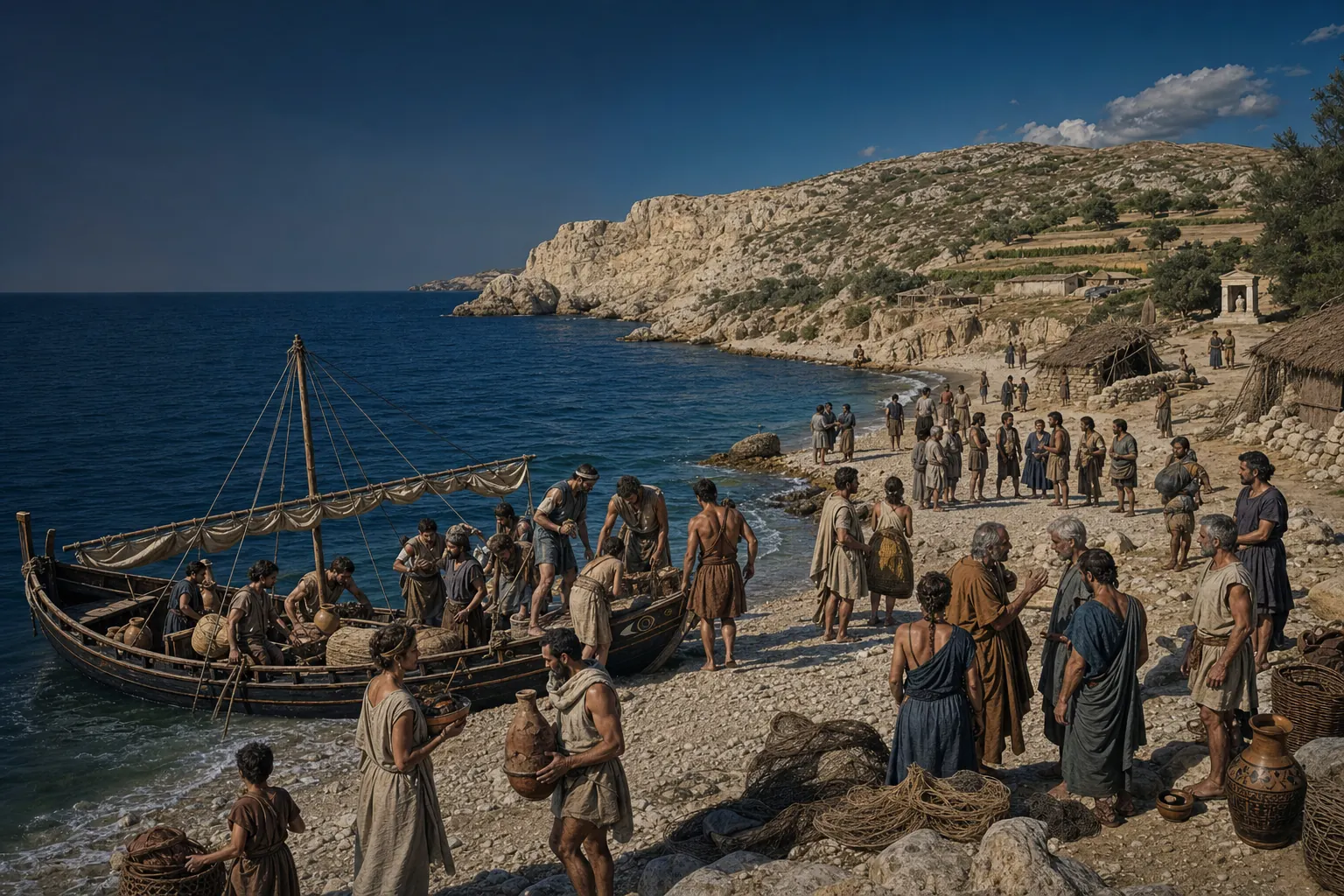
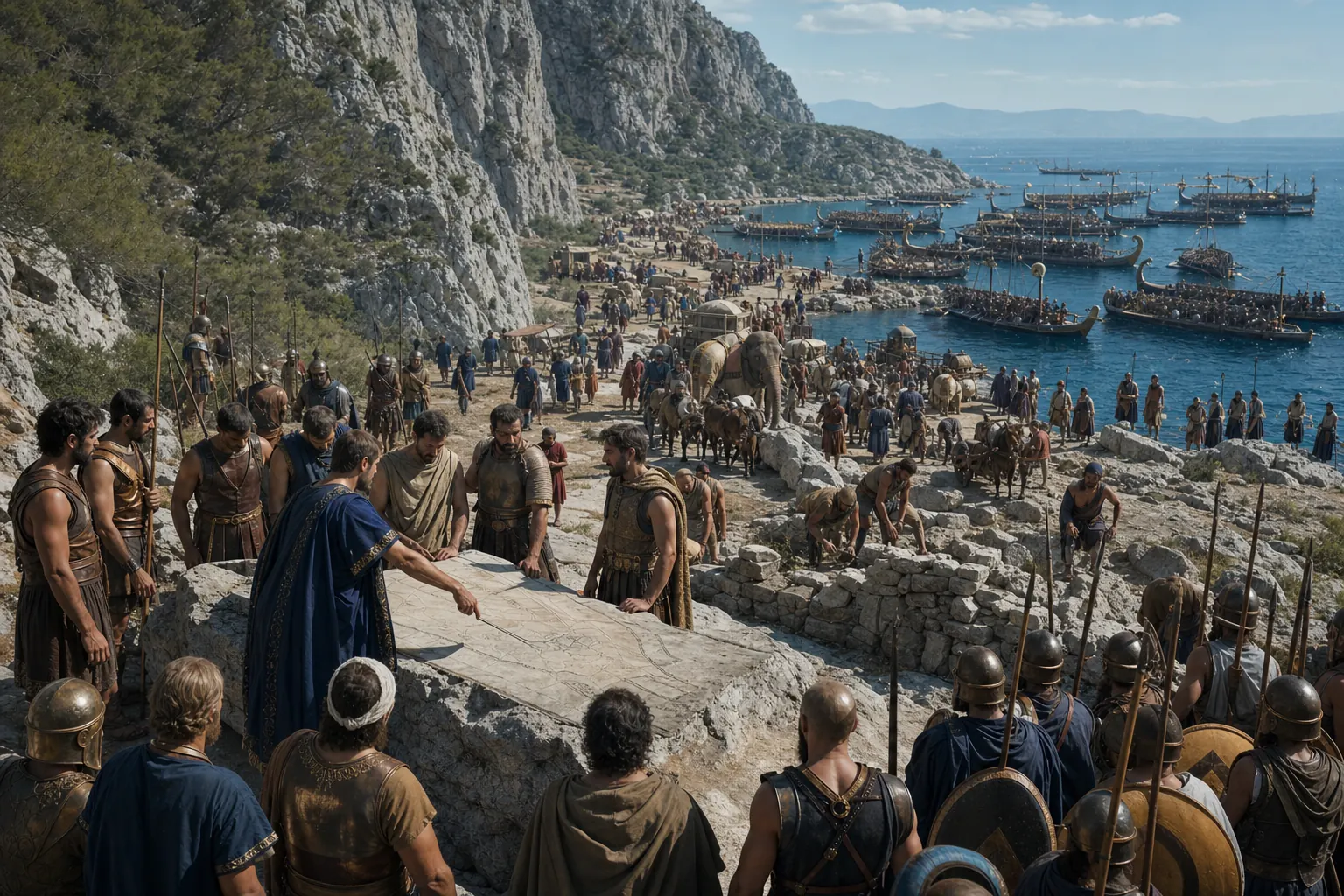
Greek settlers bring fire and household goods ashore beside an inhabited Mediterranean harbour.Place, date and surviving record

c. 750–550 BCMediterranean · Black Sea

The Polis Crosses the Sea

Greek settlers carried a political form that could be founded again without becoming one state.

A ship approaches a shore where other people already farm, trade and worship. Its passengers bring household goods, weapons, seed and fire associated with the community they left. They also bring a founder, cults and expectations about land, office and assembly. A settlement becomes a polis through acts that bind its members: dividing territory, establishing sanctuaries, choosing magistrates and deciding who may speak for the new community.

These foundations spread from the Aegean toward Sicily and southern Italy, Massalia in the western Mediterranean and coasts around the Black Sea. They seize land, make treaties, trade, fight and intermarry with existing peoples. The movement is never an empty map filling with Greek dots. Indigenous communities shape where a settlement can survive and what it becomes. Distance loosens the authority of the mother city while preserving religious and social ties.

Departure can also resolve conflict at home by sending one group toward new land, although later foundation stories often tidy disorder into a single heroic plan. Archaeology shows settlements forming by stages and populations mixing. A founder’s tomb or shared festival gives origin a focus, while plots, walls and offices turn arrival into an enduring civic claim.

The result is multiplication without political union. Hundreds of communities share language, festivals and stories while guarding separate laws and citizen bodies. New conditions invite new arrangements: one city relies on a narrow elite, another grants wider assembly power, another joins a regional federation. The polis proves portable because it is a practice of organising people and place. Its sharpest experiments now emerge in two cities that ask opposite questions of the citizen.

What survived
  • Settlement plans, sanctuaries, pottery, inscriptions and foundation traditions document Greek communities across the Mediterranean and Black Sea.
  • Archaeology records exchange, conflict and cultural mixture with existing populations rather than settlement on empty land.

Mogens Herman Hansen and Thomas Heine Nielsen, eds. (2004)Paul Cartledge (2009)

Act II · Civic power · c. 650–480 BC

Two Cities, One Coalition

Sparta and Athens build different citizen bodies, then enter an alliance that depends on both.

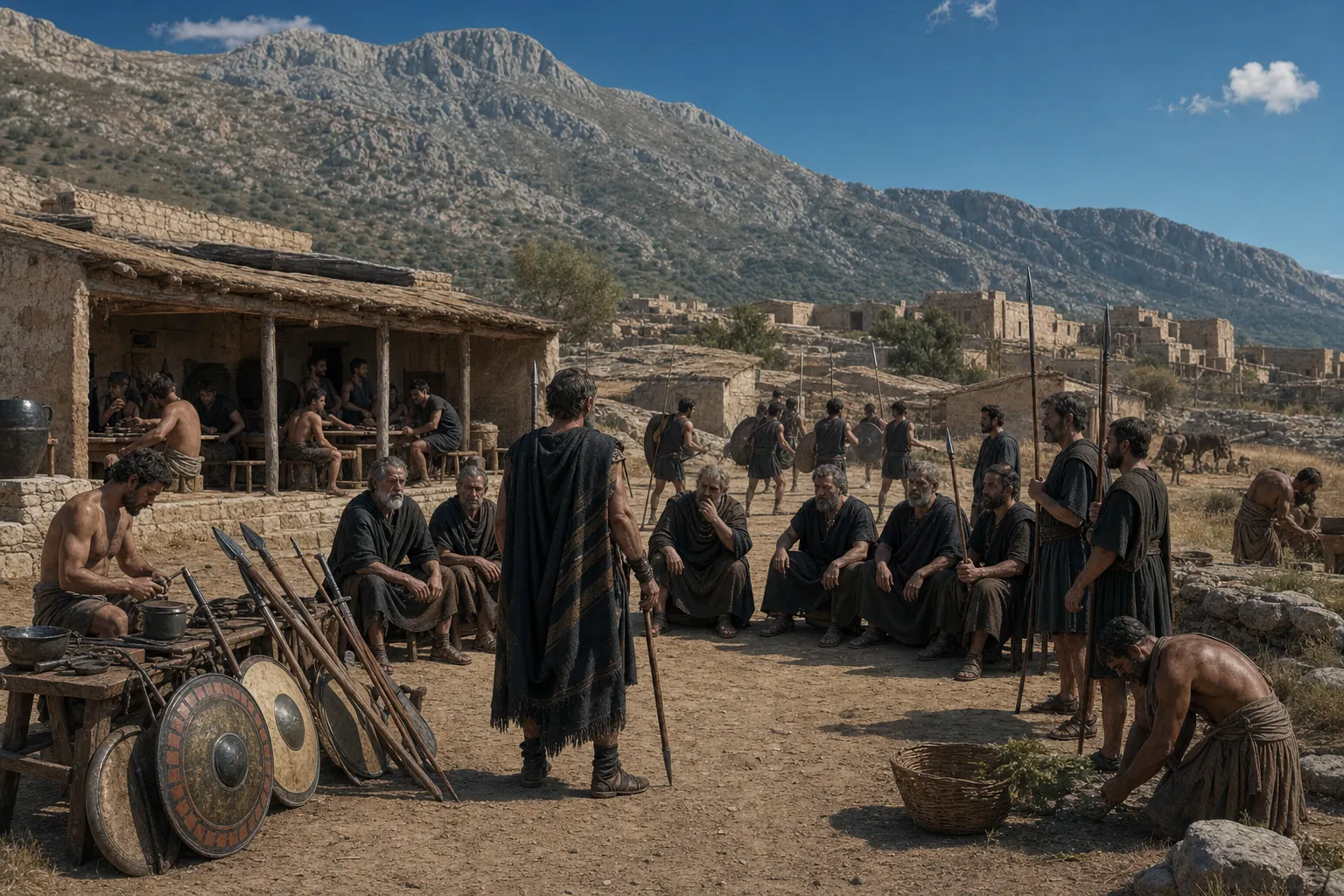
A Spartan king returns from campaign toward elders and civic overseers while mess and drill continue beyond.Place, date and surviving record

c. 650–480 BCLaconia · Messenia

Sparta Makes Citizenship a Discipline

Sparta made a small citizen body powerful by demanding a lifetime of service from it and labour from others.

A Spartan king returns from campaign with prestige, sacred duties and an army behind him. He also returns to men empowered to examine his conduct. Sparta has two hereditary kings, a council of elders, five annually chosen overseers and an assembly of citizens. Initiative and judgment move among them. The assembly does not debate like Athens, but its acclamation matters. A king can lead, negotiate and sacrifice without becoming the state.

Full citizens train for war, eat in common messes and organise reputation around endurance and obedience. Education separates boys from the household and prepares them for this adult order. The system produces soldiers able to move and hold together under pressure. It also narrows citizenship. The free communities around Sparta supply craftsmen, traders and soldiers without equal political standing. Helots work land under coercion and accompany armies while living under the threat of Spartan force.

Women of citizen families manage property and households through long military absences and perform public roles in cult and commemoration. Their prominence startled some outside observers, yet it did not place them in the assembly. Spartan society directs women and men toward the reproduction of the citizen body, while defining political membership through adult male service.

Spartan equality therefore exists inside a restricted body whose time depends on others. The fear of helot revolt shapes military caution and foreign policy. Losses among full citizens are difficult to replace. These limits never erase Sparta’s achievement: divided authority, common discipline and alliance leadership make one polis the strongest land power in Greece. When a force far larger than any city approaches, rival communities will accept Spartan command because Sparta has made civic reliability visible.

What survived
  • Literary testimony and inscriptions preserve two kings, the gerousia, ephors and citizen assembly as divided institutions.
  • Most detailed accounts of Spartan education and custom come from admiring or critical outsiders and require comparison across periods.
  • Perioikoi and helots supplied labour, craft and military service essential to the full citizen order.

M. G. L. Cooley, ed. and trans. (2023)Alberto Esu (2017)Paul Cartledge (2009)

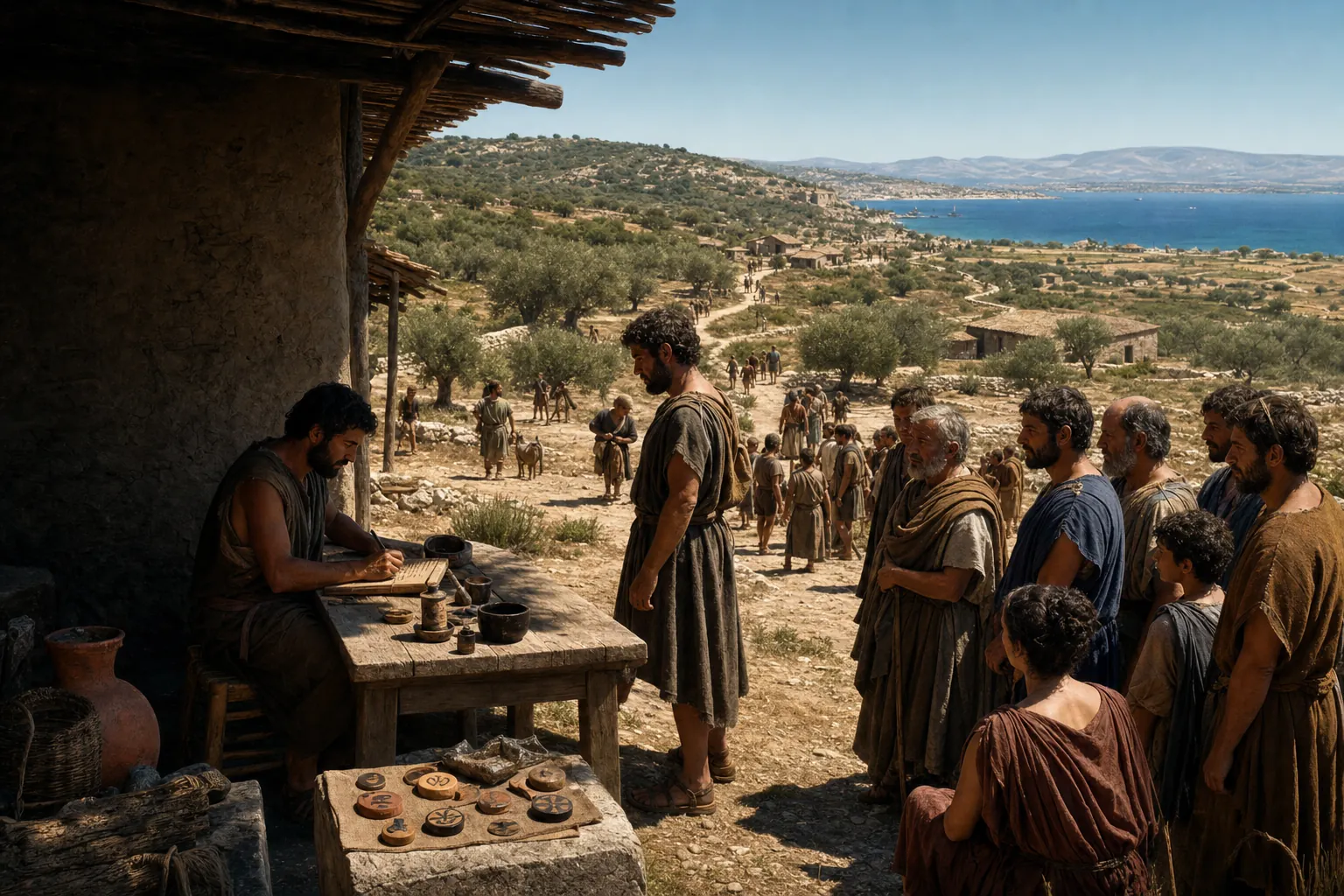
Citizens register in an Attic deme as coast, city and inland territories join into new civic tribes.Place, date and surviving record

508/7 BCAttica

Athens Makes a New People

Athens built a second political geography across old regions and family power.

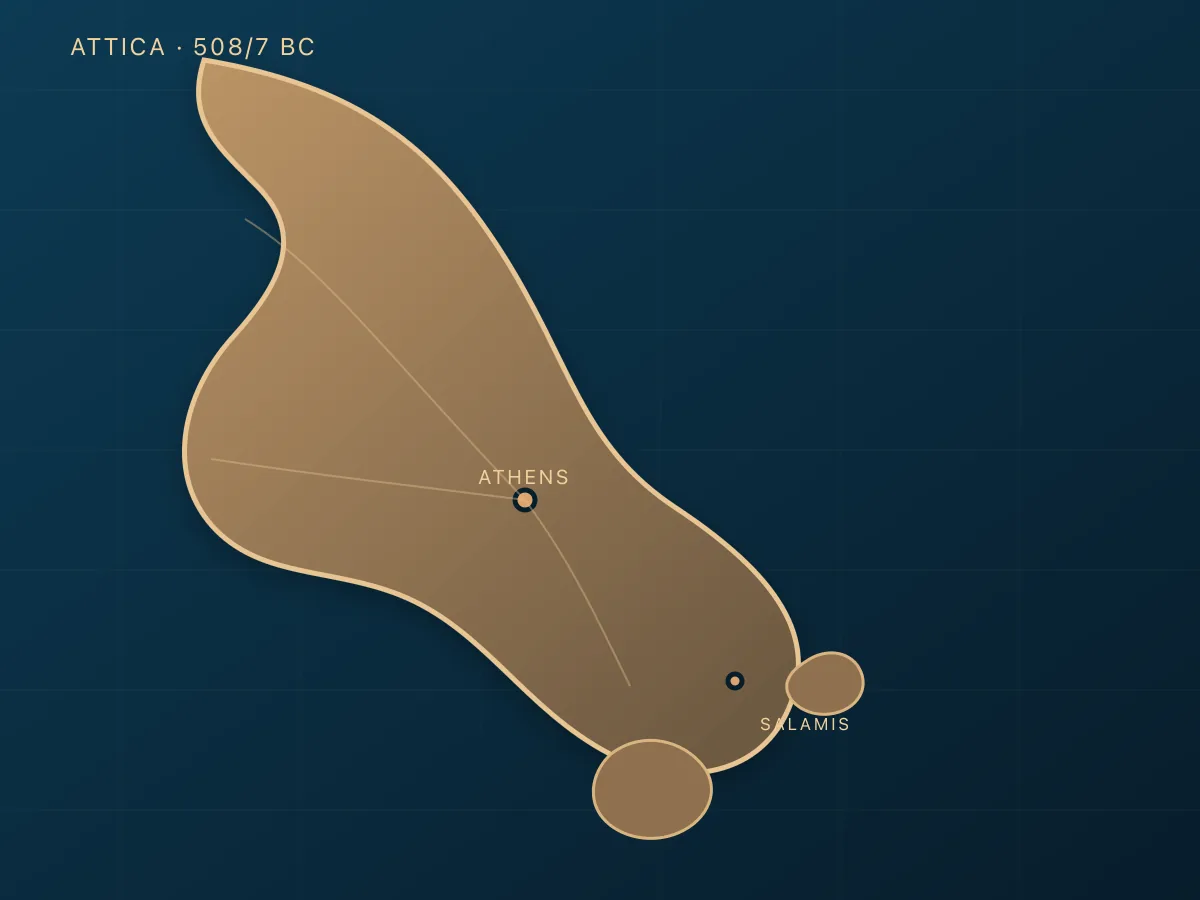
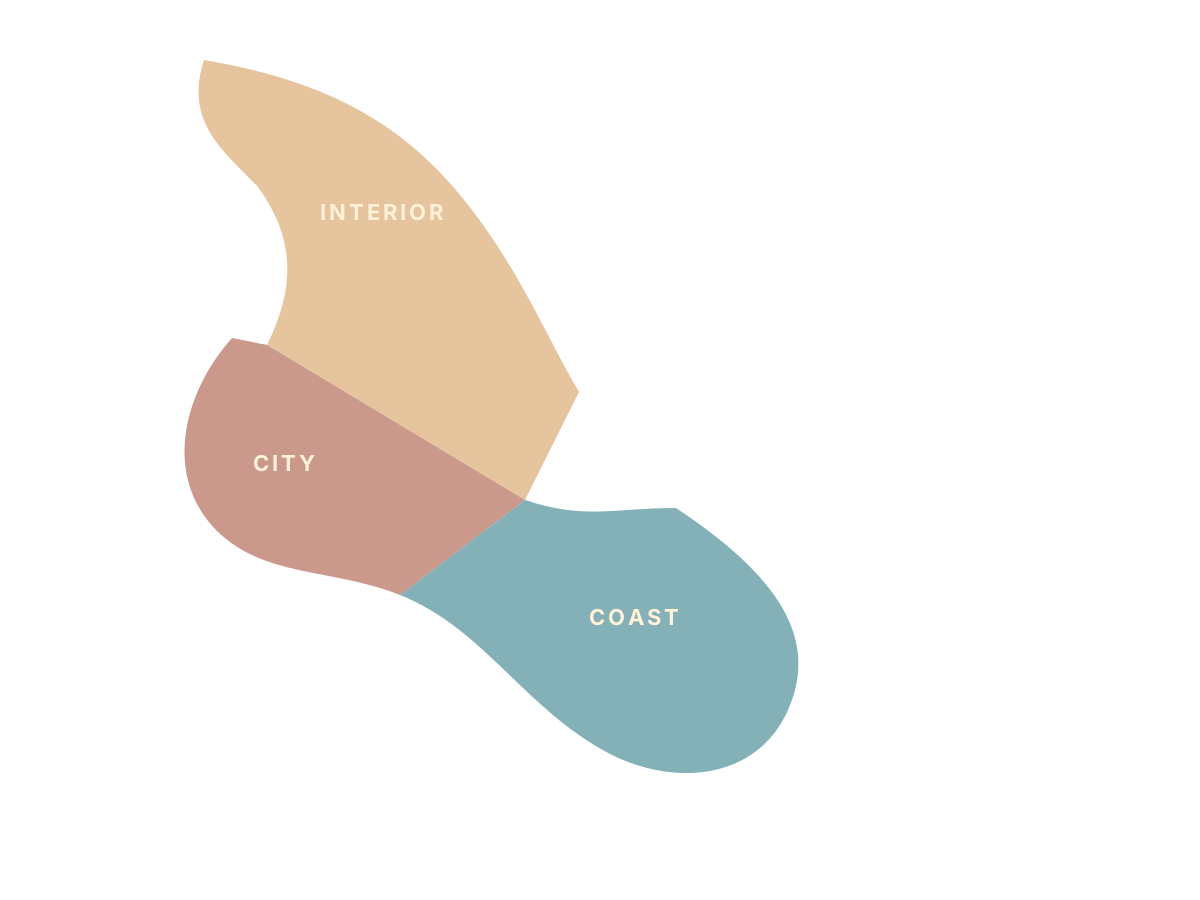
A man is entered on the register of his local community. The record places him in the territory where neighbours can challenge or confirm his standing. After the expulsion of a ruling faction, the reformer Cleisthenes uses these local units to reorganise Attica. The city does not erase village, coast or inland identity. It connects them through a political structure designed to prevent one regional bloc from owning the whole state.

Local communities called demes become the foundations of registration. Groups of them form thirty intermediate units, drawn from the city, coast and interior. Three of those units combine into each of ten tribes. Every tribe therefore joins men from separated parts of Attica. Fifty citizens from each tribe serve on a Council of 500 that prepares business for the assembly. Military and festival organisation reinforce the same new divisions.

A citizen now identifies himself publicly through his deme as well as his personal and family name. The new tribes compete in choral festivals, muster military units and take turns at the centre of council business. Administration becomes lived association: men who might never share a village acquire repeated reasons to deliberate, march and celebrate together.

The design gives institutional form to the people who had resisted an attempted oligarchic settlement and recalled Cleisthenes. It does not end aristocratic influence or make every inhabitant a citizen. It creates machinery through which a wider male citizen body can act repeatedly across a large territory. Sparta makes reliability through discipline; Athens makes collective capacity through recombination. Both systems now face an empire able to command roads, tribute, ships and armies across continents.

What survived
  • Deme records, later constitutional accounts and civic inscriptions preserve the territorial logic of Cleisthenic organisation.
  • Ten tribes each supplied fifty members to the Council of 500 and also organised military and festival participation.
  • The people’s mobilisation during the political crisis formed part of the reforms’ success.

Josine Blok (2017)Paul Cartledge (2009)

Build a people across Attica

Four map states move from old regional power through local registration and mixed tribes to the Council of 500.

City, coast and interior contain old communities and competing centres of influence.

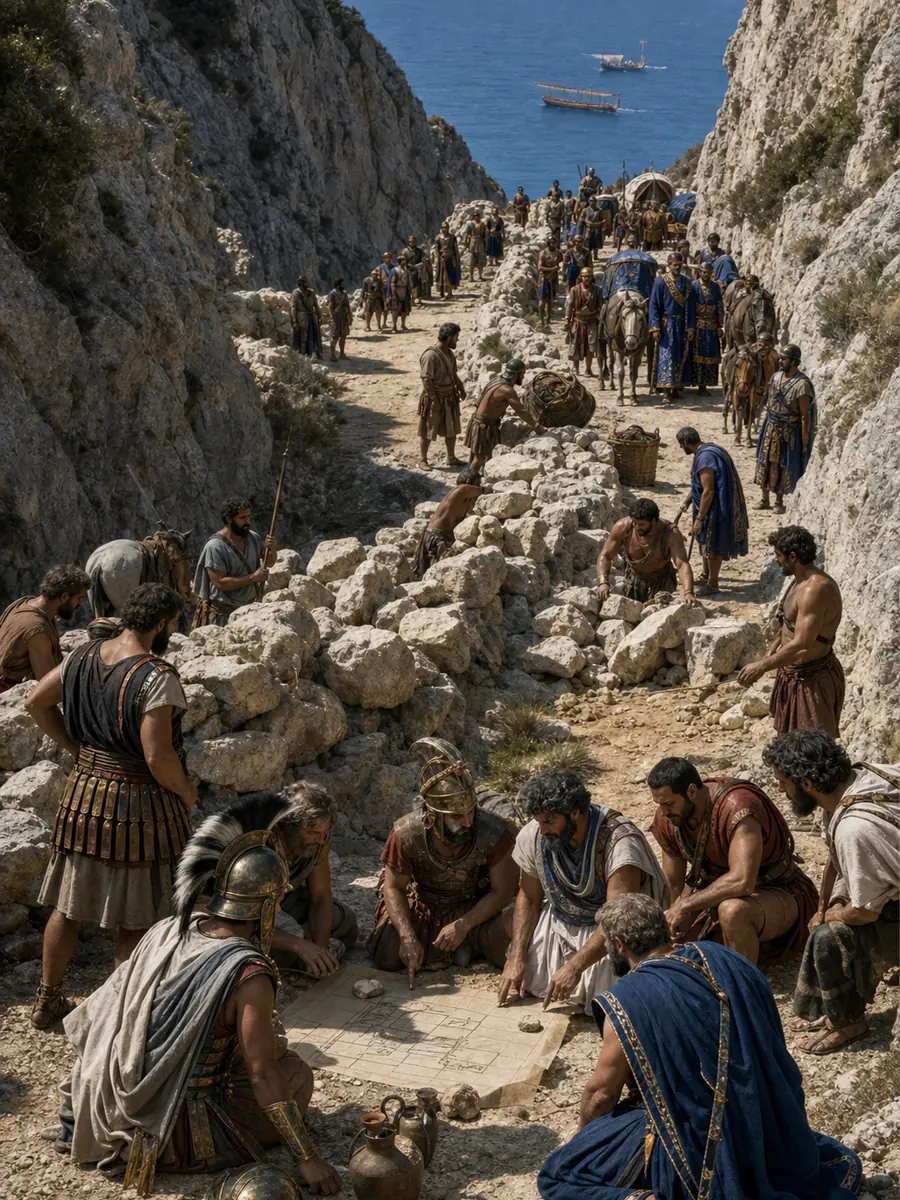
Greek delegates accept Spartan command as soldiers close the pass at Thermopylae and allied ships wait offshore.Place, date and surviving record

481–480 BCIsthmus · Thermopylae · Artemisium

The League Follows Sparta

Independent cities accepted Spartan command because resistance required a leader others expected to hold.

Delegates meet while the Persian king Xerxes prepares to cross into Europe. His empire draws soldiers, ships, tribute and supplies from many peoples, including Greek communities in Asia and cities that choose submission. The resisting cities quarrel over where to defend and which homes can be sacrificed. They need command credible beyond one battlefield. Sparta possesses the strongest land reputation and an established alliance, so the coalition follows Sparta.

The Spartan king Leonidas takes a force to Thermopylae while an allied fleet guards the nearby straits. When the pass is turned, he dismisses much of the army and remains with his Spartiates, Thespians, a disputed Theban contingent and helots visible among the dead in Herodotus’ account. Their destruction does not stop the invasion. It opens central Greece and exposes Athens. The sacrifice gives coalition leadership a standard Sparta has paid to uphold.

Persian strength comes from administration as much as scale. Storehouses, depots, roads and naval contingents allow the royal army to cross territories no polis could organise alone. Command includes Persians and other imperial elites, while subject communities retain languages, weapons and local leaders. The coalition is resisting a sophisticated political order, not an anonymous mass.

Spartan authority also reaches the sea. Eurybiades holds formal command of the allied fleet at Artemisium and later Salamis, although Athens supplies the largest contingent. Command, contribution and strategic persuasion belong to different actors. The fleet withdraws; the pass is lost; submission remains possible. Athens now makes a decision that no city can reverse: families leave their homes while the political community moves toward the ships.

What survived
  • Herodotus names the contingents, command disputes and decisions through which the resisting coalition formed.
  • The Theban role at the final stand remains disputed; Herodotus presents coercion and later surrender.
  • Herodotus 8.25 places helots among the dead revealed after the battle.

Herodotus (fifth century BC)Thomas Clements (2024)Matthew A. Sears (2023)M. G. L. Cooley, ed. and trans. (2023)

Act III · Freedom and command · 480–432 BC

Freedom Becomes Power

Victory preserves autonomous cities, expands Athenian participation and turns alliance into rule.

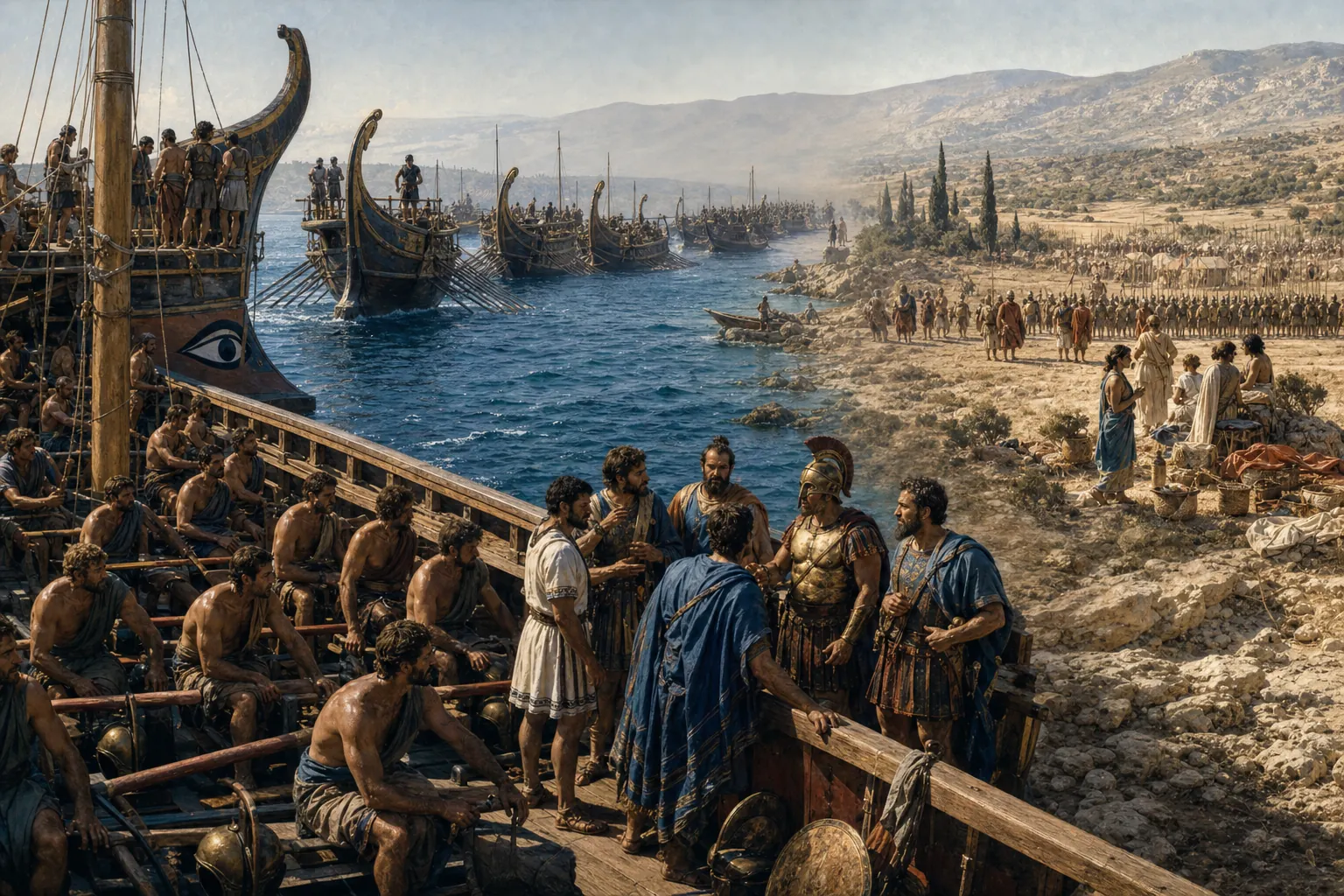
Athenian rowers drive allied triremes through Salamis as the scene resolves into the Greek line at Plataea.Place, date and surviving record

480–479 BCSalamis · Plataea · Mycale

The Cities Survive Together

Greek autonomy survived because different cities supplied strengths no single polis possessed.

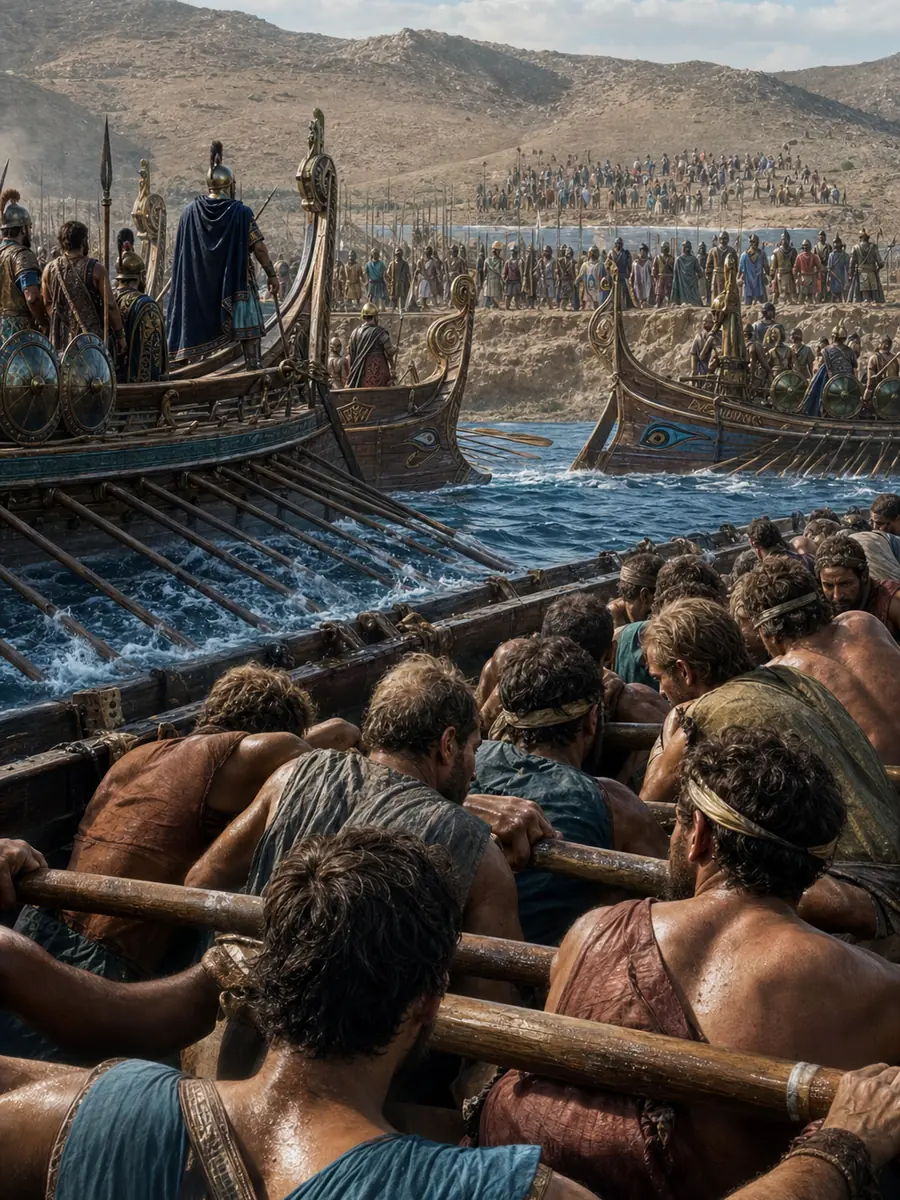
Athenian families leave the city while rowers take their places on crowded benches. Silver income, public votes and years of shipbuilding have created the largest contingent in the allied fleet. The Athenian strategist Themistocles argues that restricted water near Salamis can cancel Persian numbers. Eurybiades accepts the setting and commands the coalition that fights there. The victory belongs to thousands of rowers and to allied ships holding one line under pressure.

Salamis keeps resistance alive without ending the invasion. The following year an allied land army gathers under the Spartan regent Pausanias near Plataea. The coalition strains over position and supply before Persian attack forces the decision. Spartan and Tegean troops break the force around Mardonius while Athenians fight Greek allies of Persia. A second allied victory at Mycale carries the war back toward the eastern Aegean.

Herodotus makes disagreement part of the achievement. Commanders threaten withdrawal, cities dispute honour and individuals calculate survival. Some Greek states fight for Xerxes; others wait. The alliance holds at the moments when divided communities accept one place in a line and one sequence of command. Cooperation is therefore an action repeatedly chosen under danger, not a settled Greek unity.

The cities survive together, not because they become one nation, but because a temporary structure aligns unequal contributions. Athens supplies naval mass and the decision to abandon its city. Sparta supplies coalition legitimacy and the land command at Plataea. Smaller allies supply ships, soldiers, local ground and political endurance. Freedom now means that a polis can make its own decisions. Victory gives Athens the fleet and confidence to organise that freedom under its own leadership.

What survived
  • Herodotus records fleet contributions, command, debate and battle sequences while shaping them through speeches and inquiry.
  • Athenian silver, dockyards and public mobilisation made the largest Greek naval contribution possible.
  • Plataea and Mycale were consequential allied victories rather than captions after Salamis.

Herodotus (fifth century BC)David M. Pritchard (2018)Matthew A. Sears (2023)

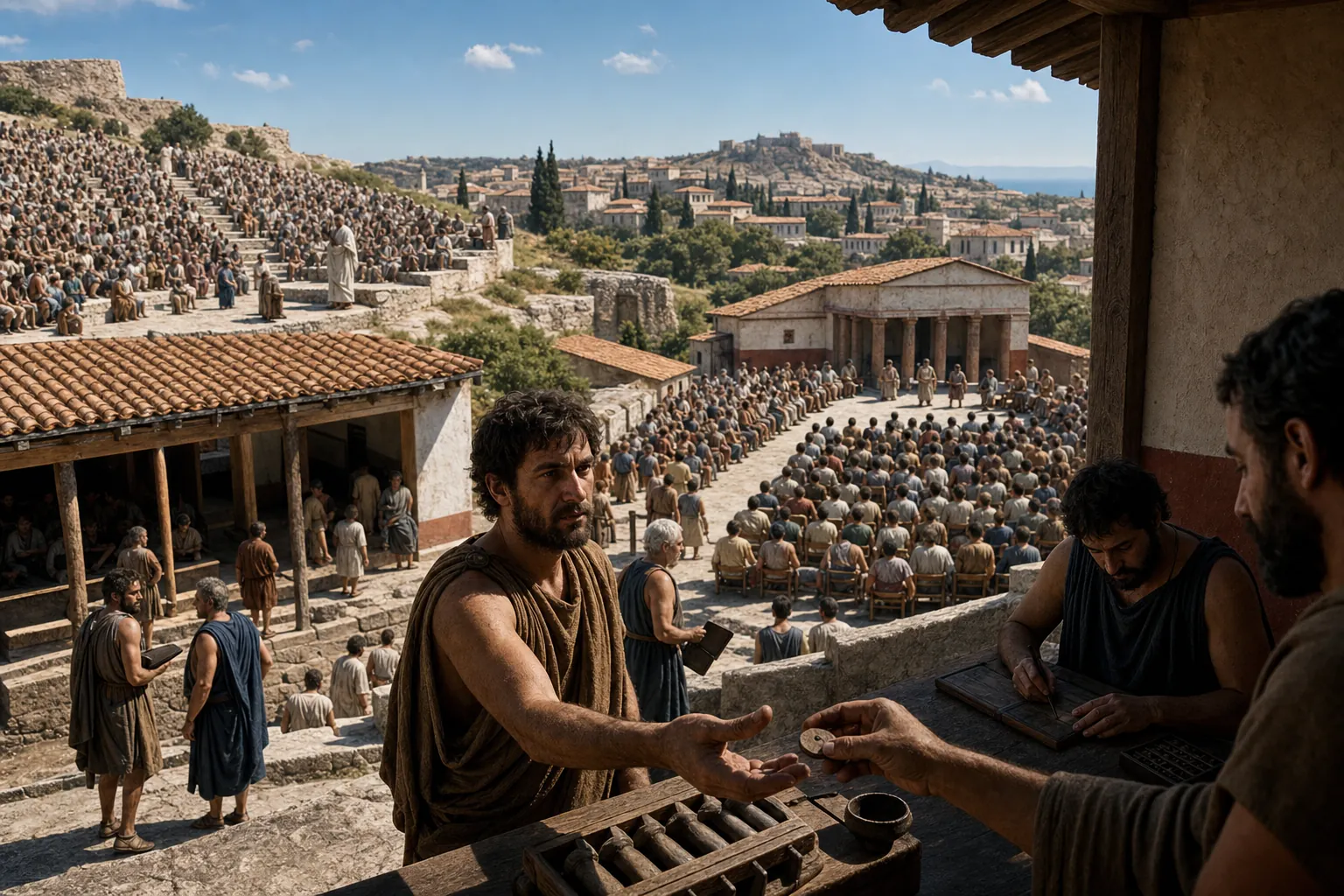
An ordinary Athenian citizen receives a lot token before the Pnyx, council chamber and law court.Place, date and surviving record

c. 462–430 BCAthens

The People Take Their Place

Athens made government repeated work for thousands of ordinary citizens.

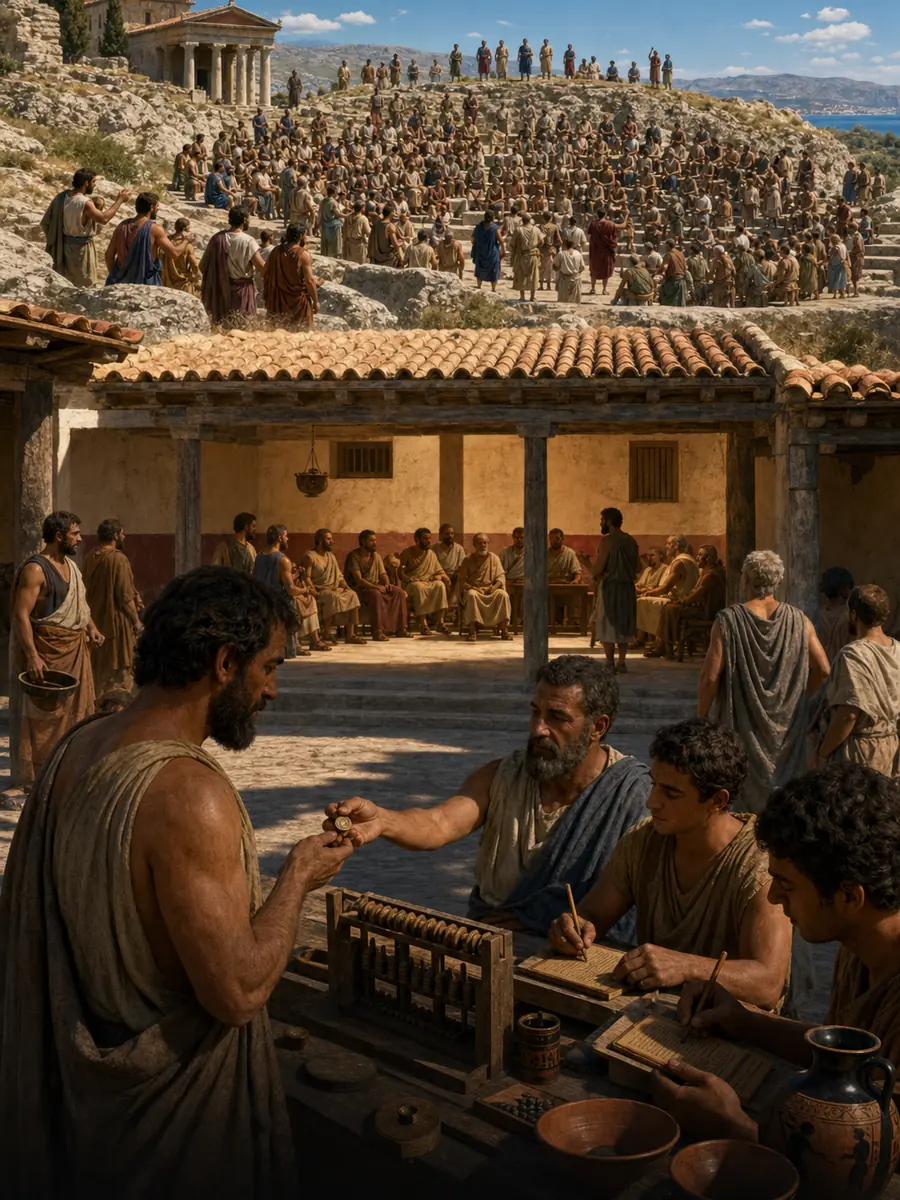
An ordinary citizen’s name is drawn, and public responsibility arrives without fame or a private campaign. He may spend a year on the Council preparing business, sit for a day among a large jury or walk to the assembly where every eligible citizen can vote. Rotation and selection by lot spread office across a body too large to become a permanent governing class. Election remains for posts where recognised skill, especially military command, carries greater weight.

Procedure makes participation powerful. The Council receives envoys and prepares an agenda. A herald opens the assembly floor. Speakers offer proposals before thousands who can shout, listen and decide. Jurors hear litigants without a professional judge delivering the verdict. Magistrates face examination before service and accounting afterward. Public pay allows poorer citizens to surrender working time for jury and office. Records, finance and clerks give repeated decisions administrative memory.

Participation is learned through recurrence. A councillor discovers the cost of a fleet from accounts, a juror hears rival readings of law, and an assembly voter sees a decree return as expenditure or war. Citizens do not need equal eloquence or expertise to share responsibility. Institutions distribute fragments of knowledge, then require a public decision from them.

The citizen body has a hard edge. Citizen women carry legitimate descent, property claims and central cults without voting in assembly or jury. Resident foreigners trade, manufacture and fight while excluded from equal political authority. Enslaved people work in households, mines and public tasks. The system’s reach and its exclusions grow together. Athens has made direct participation operate at exceptional scale, and the same public machinery now directs tribute, garrisons and fleets beyond Attica.

What survived
  • Allotment equipment, voting ballots, decrees, court speeches and institutional sites preserve repeated citizen participation.
  • Payment for jury and office service widened practical access among eligible citizens.
  • Descent rules, cult practice and legal records reveal women, resident foreigners and enslaved people inside the city but outside equal political power.

Josine Blok (2017)David M. Pritchard (2018)Matthew Simonton (2026)

Take one place in the city

Three deterministic paths follow an eligible citizen through council, jury or assembly and end with the responsibility attached to the decision.

  1. Qualify

    Public scrutiny checks citizenship and conduct before service begins.

  2. Prepare

    The Council receives business, supervises officials and frames proposals.

  3. Answer

    Service ends with an accounting that can expose misconduct.

Public responsibilityTemporary authority returns to the citizen body that granted it.

A citizen selected for the Council serves with fifty men from his tribe inside a rotating body of 500.

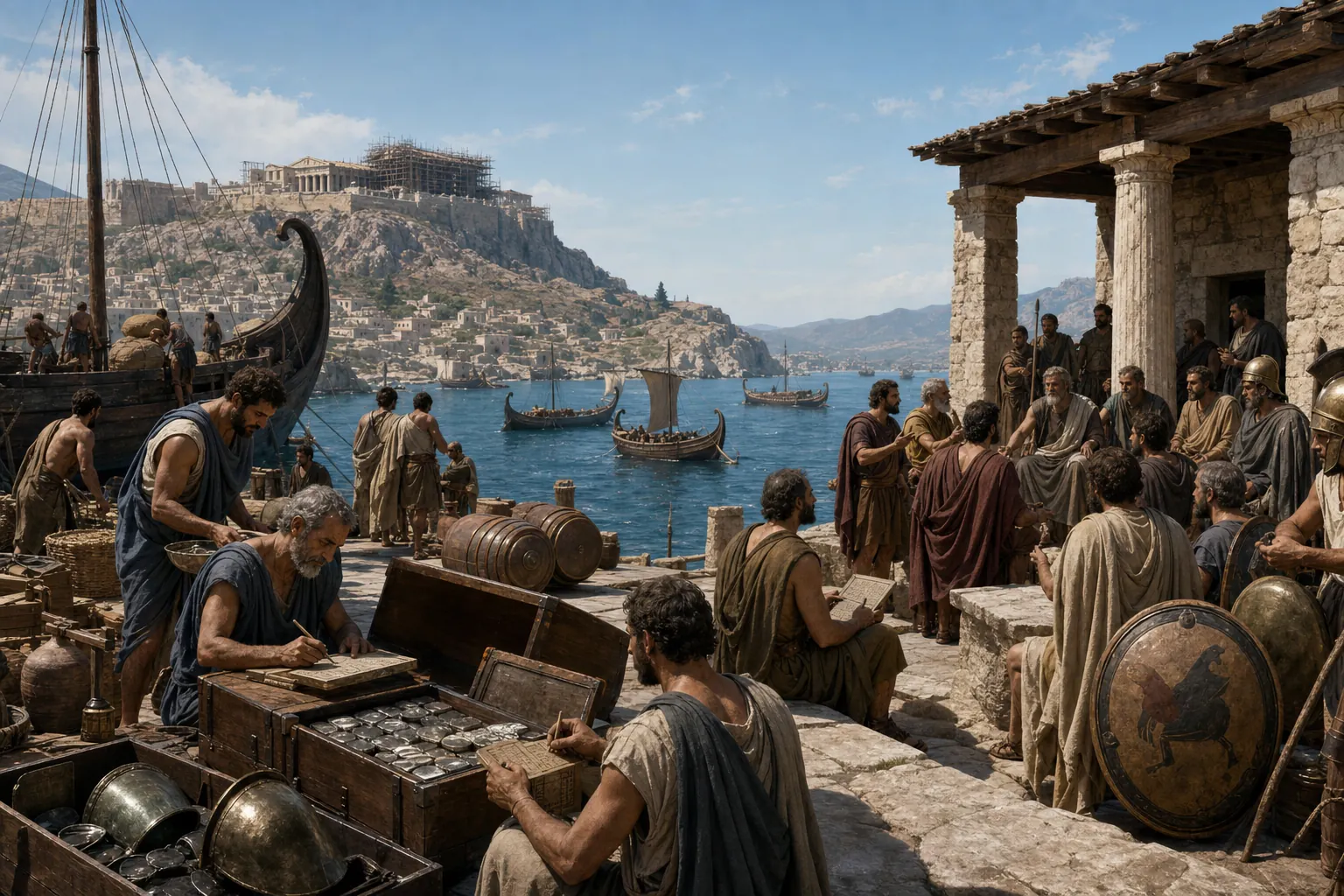
Allied tribute converges on Athens while delegates gather around Sparta across a divided Aegean.Place, date and surviving record

478–432 BCDelos · Athens · Sparta · Corinth

Two Freedoms Divide Greece

Athenian protection and Spartan autonomy became rival claims about who kept Greek cities free.

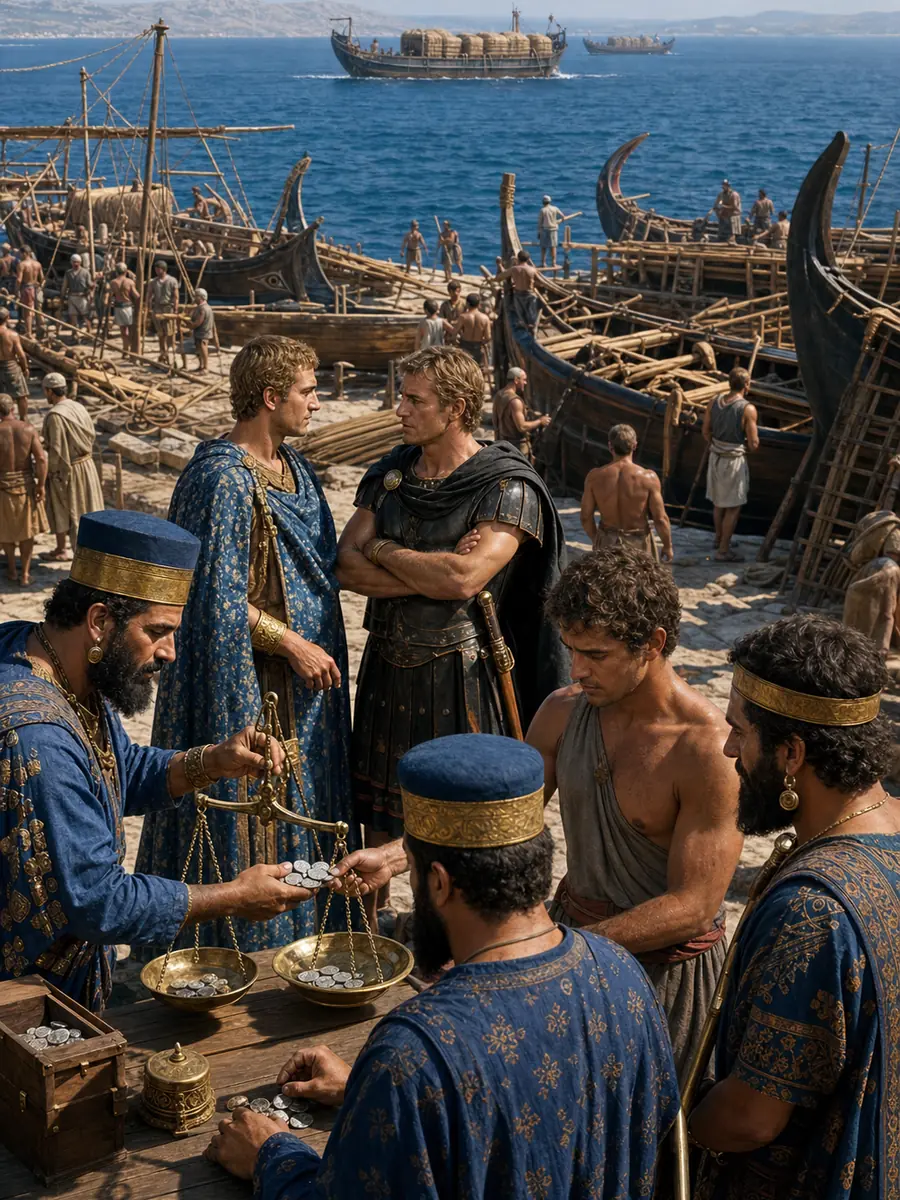
A city sends a ship or payment to continue the war against Persia. The alliance treasury begins on sacred Delos, and Athens supplies leadership and the largest fleet. Over time, contributing money becomes easier for many members than maintaining ships. Athens collects the assessment, prevents secession and uses force against revolt. The treasury moves to Athens. Allied resources support war, civic pay, dockyards and monuments under decisions made by the Athenian people.

Sparta presides over another alliance whose members retain armies, governments and their own reasons for war. Corinth fears for trade and colonial interests. Thebes seeks regional power. Allies vote and pressure Sparta; the hegemon cannot treat them as subjects marching under one national command. Both systems speak of freedom. Athens presents security and continued war against Persia. Its opponents define freedom as the autonomy to reject Athenian decrees.

Institutions convert these claims into power. Athenian citizens vote how allied payments are assessed and spent; juries hear some disputes brought from allied cities; officials and garrisons enforce decisions abroad. Spartan assemblies decide whether to lead forces requested by allies, while allied congresses give smaller states a formal voice. Neither system is a simple mask. Each makes one version of freedom practical for some communities and restrictive for others.

The conflict does not arise from constitutions mechanically seeking enemies. Disputes at Corcyra, Potidaea and Megara test credibility, obligation and restraint. Corinth pushes for action; Spartan leaders disagree about timing and risk. Thucydides later makes the growth of Athenian power and Spartan fear central to his explanation, while his own narrative preserves choices that could have gone differently. In 432, rival alliances turn arguments about freedom into preparations for war.

What survived
  • Athenian tribute lists, decrees and revolt settlements document the alliance’s transformation into command.
  • Thucydides distinguishes underlying growth and fear from the publicly stated disputes he narrates.
  • Corinthian and Theban aims show allied agency inside the Spartan alliance.

Thucydides (late fifth century BC)Polly Low (2025)Robin Osborne (2025)David M. Pritchard (2018)

Act IV · The long war · 431–146 BC

The War for the Greek World

Athens and Sparta search for a decisive form of war, then discover that victory cannot end the constitutional argument.

An Athenian farmer watches Attic fields burn from the Long Walls as Spartan prisoners cross from Sphacteria.Place, date and surviving record

431–421 BCAttica · Pylos · Sphacteria · Amphipolis

The War Finds No Decisive Field

Sparta could devastate Athens and Athens could humiliate Sparta without either system forcing an end.

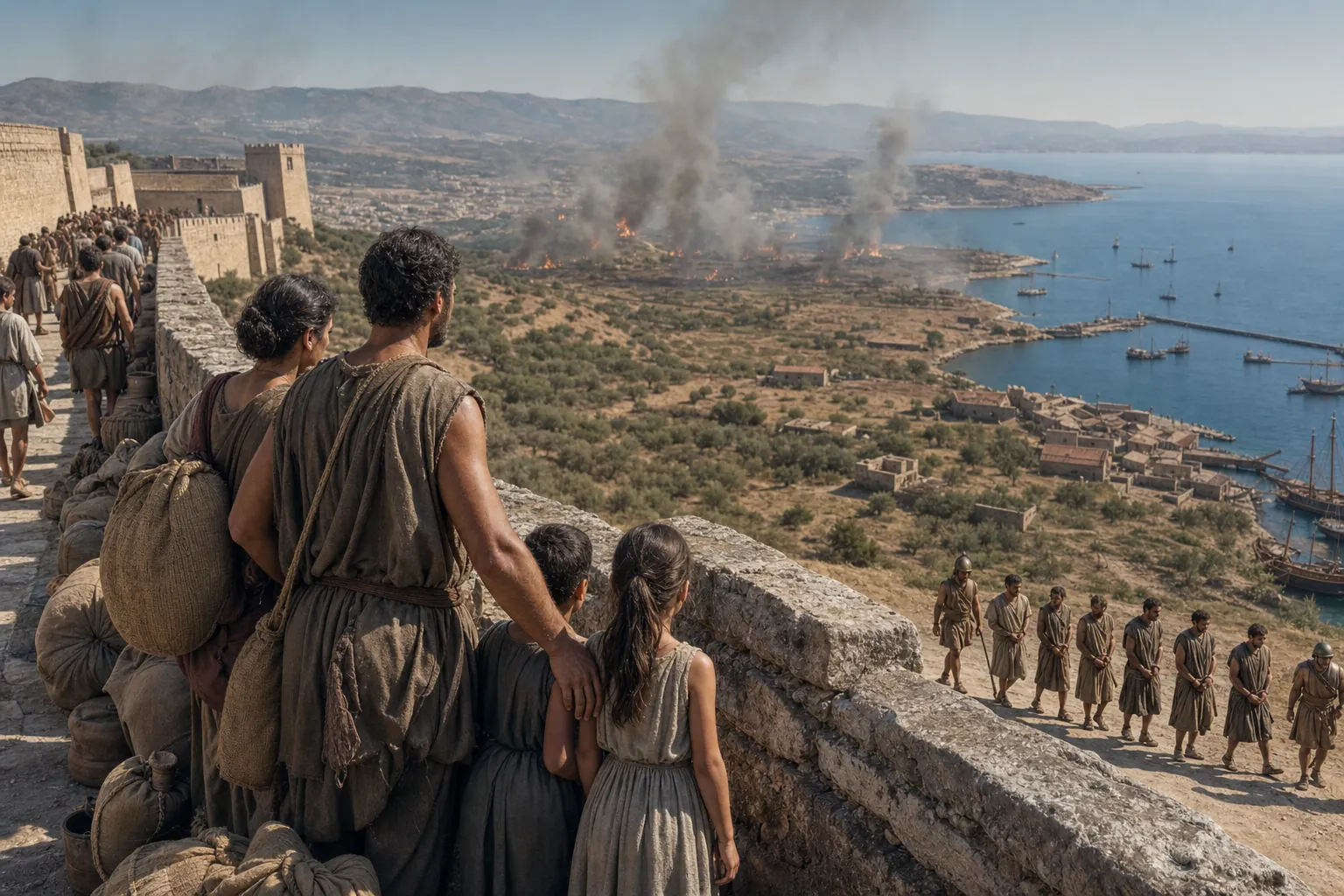
An Athenian farmer watches Spartan soldiers cut crops and burn buildings while his own leaders forbid the expected battle. The strategist Pericles has brought the rural population behind the Long Walls. Athens will use imported grain, money and ships rather than risk its citizen army against Sparta’s strength. The strategy protects the city from a land decision and crowds people into conditions where plague kills citizens, soldiers and Pericles himself.

Athens raids by sea, suppresses allied revolt and uses fortified positions around the Peloponnese. At Pylos in 425, an improvised operation traps Spartan troops on the island of Sphacteria. They surrender. The prisoners overturn the expectation that full Spartan citizens always die rather than yield and give Athens leverage against future invasions. Sparta answers through the commander Brasidas, whose speed and promises of liberation draw northern allies away from Athens.

War changes the public that directs it. The plague overturns confidence in plans and rituals; repeated service strains crews, finances and households. Assembly decisions respond to news that arrives late and through interested speakers. The same procedures capable of strategic adaptation can accelerate anger, as the debates over revolt at Mytilene reveal when one decision is reversed the following day.

Brasidas and the Athenian politician Cleon die at Amphipolis. Exhaustion and political opportunity produce the Peace of Nicias in 421, but major allies reject parts of the settlement and neither alliance loses its means of war. The first decade has revealed the structural problem. Land invasion cannot penetrate walls and naval empire cannot remove Spartan power. Peace closes one phase while leaving both sides searching for a different way to decide the conflict.

What survived
  • Thucydides records annual invasions, plague, naval operations and the campaign sequence through the Peace of Nicias.
  • The capture of full Spartan citizens at Sphacteria changed bargaining power and contemporary expectations.
  • Brasidas combined military movement with political appeals to cities inside the Athenian system.

Thucydides (late fifth century BC)Hans van Wees (2025)David M. Pritchard (2018)

Persian silver pays a Spartan fleet as Sicily, Decelea and the closed grain route appear across the war map.Place, date and surviving record

421–403 BCSicily · Decelea · Ionia · Athens

Persia Gives Sparta the Sea

Sparta won after it changed its war, accepted Persian finance and sustained a fleet against Athens.

A magnificent Athenian expedition enters Sicily in 415. Its leaders carry competing purposes, and the target expands from support for allies toward control of Syracuse. The Syracusans resist, Corinth sends help and the Spartan officer Gylippus brings command experience. Fortifications meet counter-walls. The final Athenian ships cannot escape the harbour. Army and fleet are destroyed, and surviving prisoners march toward captivity in the quarries.

Athens continues fighting for almost a decade. Sparta fortifies Decelea in Attica and replaces seasonal invasion with continuous pressure. Enslaved workers escape; land routes constrict; allied revolt spreads. An oligarchic coup overturns the democracy in 411 while the fleet at Samos refuses the new government. Athens rebuilds naval strength and wins at Arginusae in 406, then condemns victorious generals through a constitutionally disputed collective trial after drowned crews remain unrecovered.

The narrative itself now changes hands. Thucydides stops during the crisis of 411, before the outcome he had framed. Xenophon resumes with fleets, negotiations and shifting commanders, writing from a different political and personal position. The seam matters because no ancient account gives an innocent view from above. Reconstructing the final war requires following both events and the interests of those who arranged them.

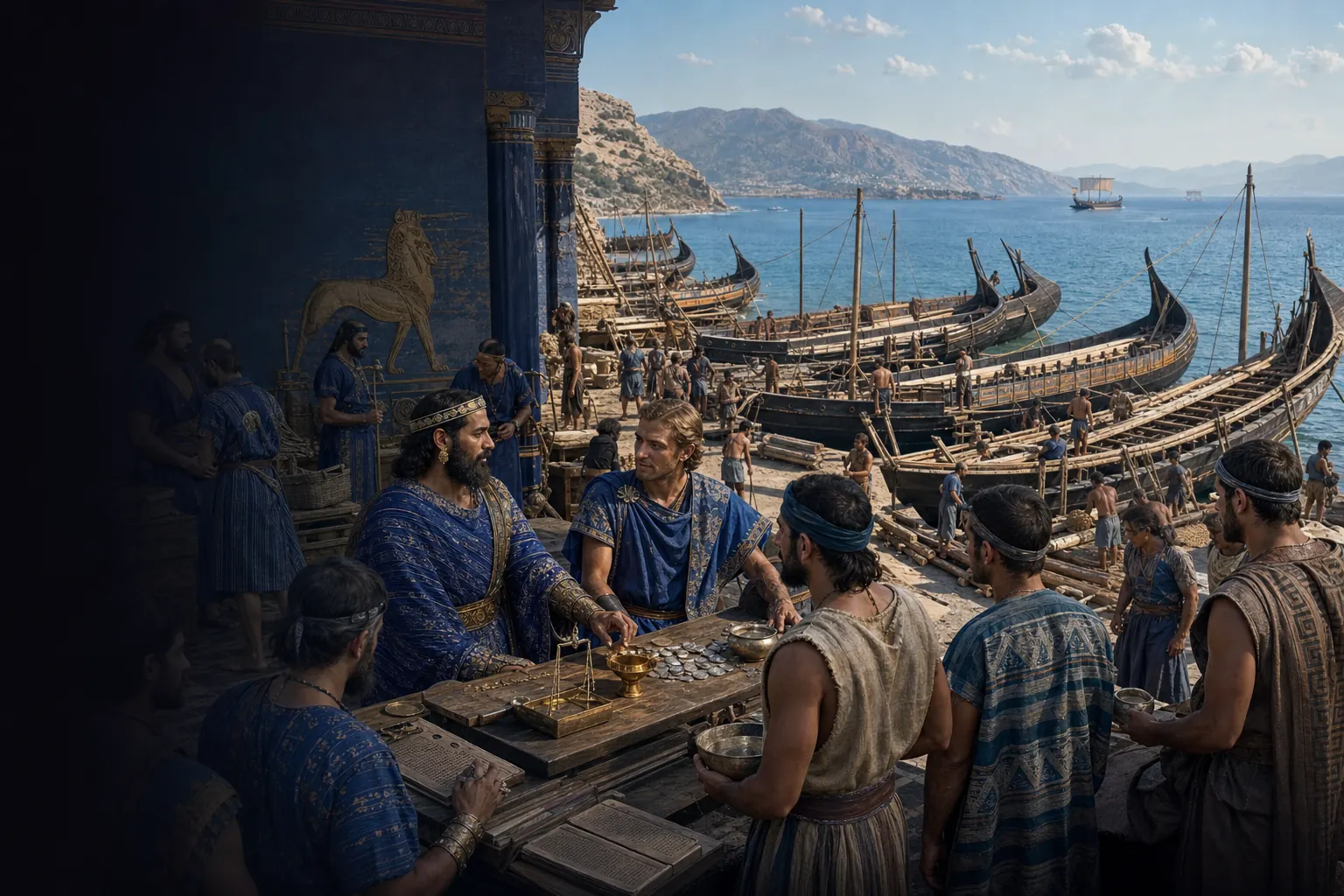
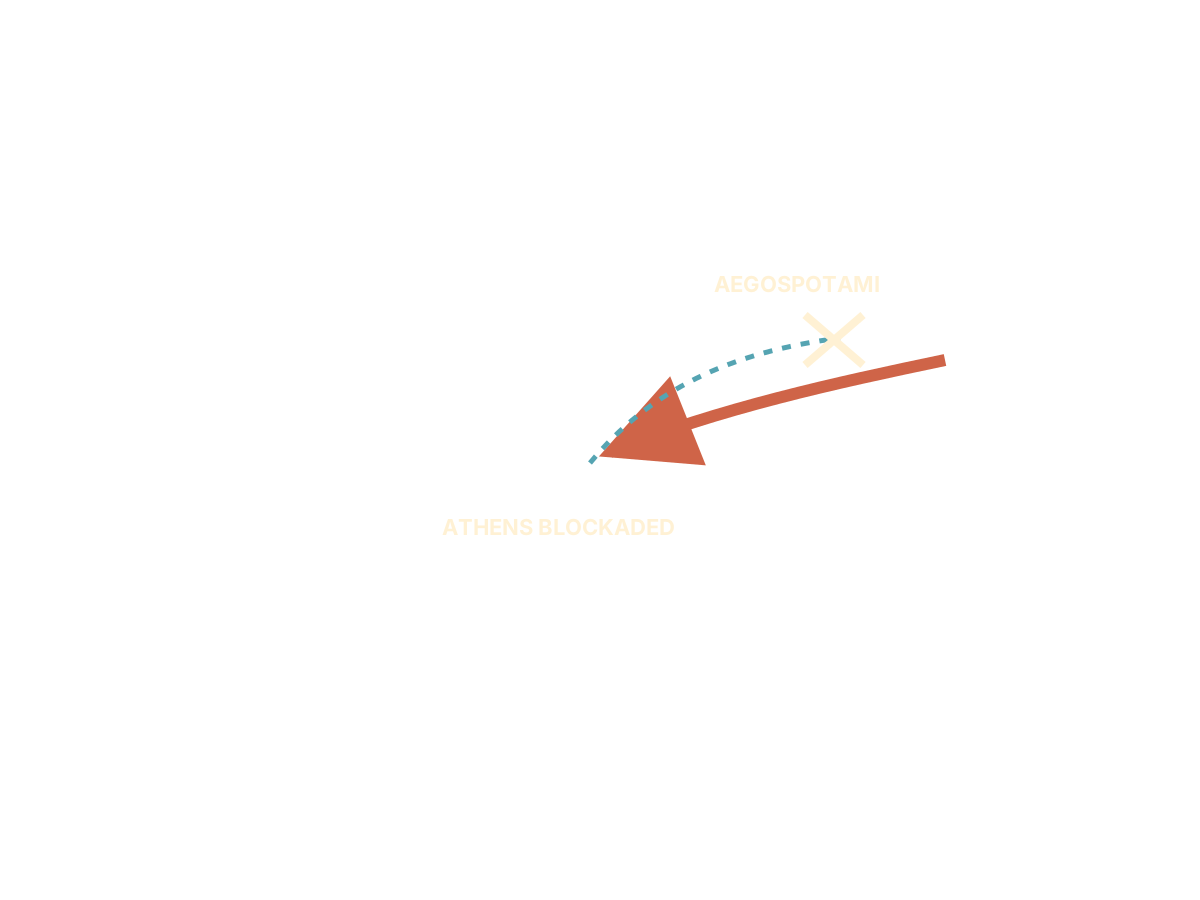
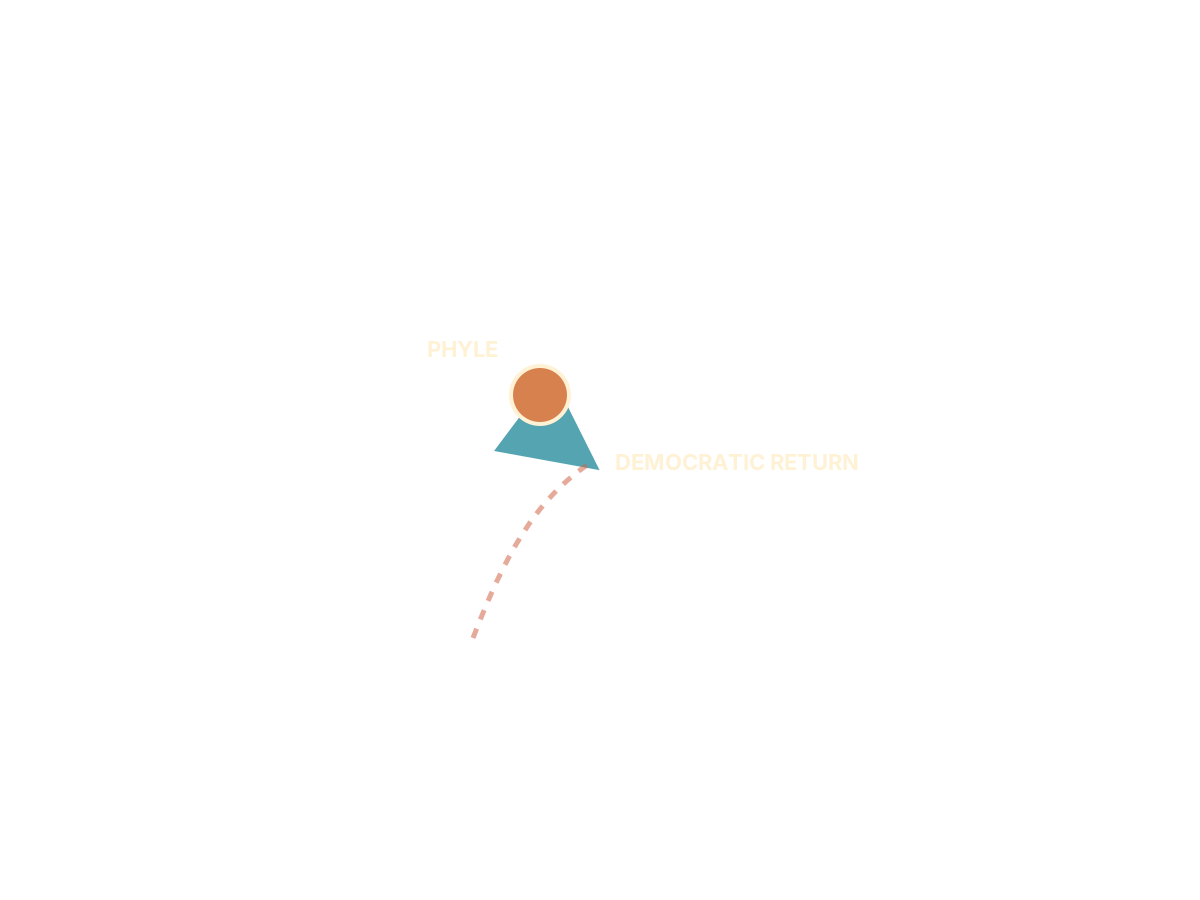
Persian money changes what Sparta can sustain. The prince Cyrus finances crews and forms a powerful relationship with the Spartan commander Lysander. Paid fleets can return after defeat and wait for Athenian error. At Aegospotami in 405, Lysander captures the fleet and closes the grain route. Athens surrenders. Sparta refuses calls to destroy the city in Xenophon’s account, then installs the Thirty, whose killings turn liberation into imposed rule. Democratic exiles gather at Phyle.

What survived
  • Thucydides ends in 411; Xenophon becomes a principal continuous narrator for the war’s final years.
  • Persian subsidies and Cyrus’ relationship with Lysander made repeated Spartan naval mobilisation possible.
  • Athens survived the Sicilian destruction, the Decelean occupation and internal revolution before Aegospotami closed its supply route.

Thucydides (late fifth century BC)Xenophon (fourth century BC)Samuel Gartland and Robin Osborne, eds. (2025)Polly Low (2025)

Watch the war search for a decision

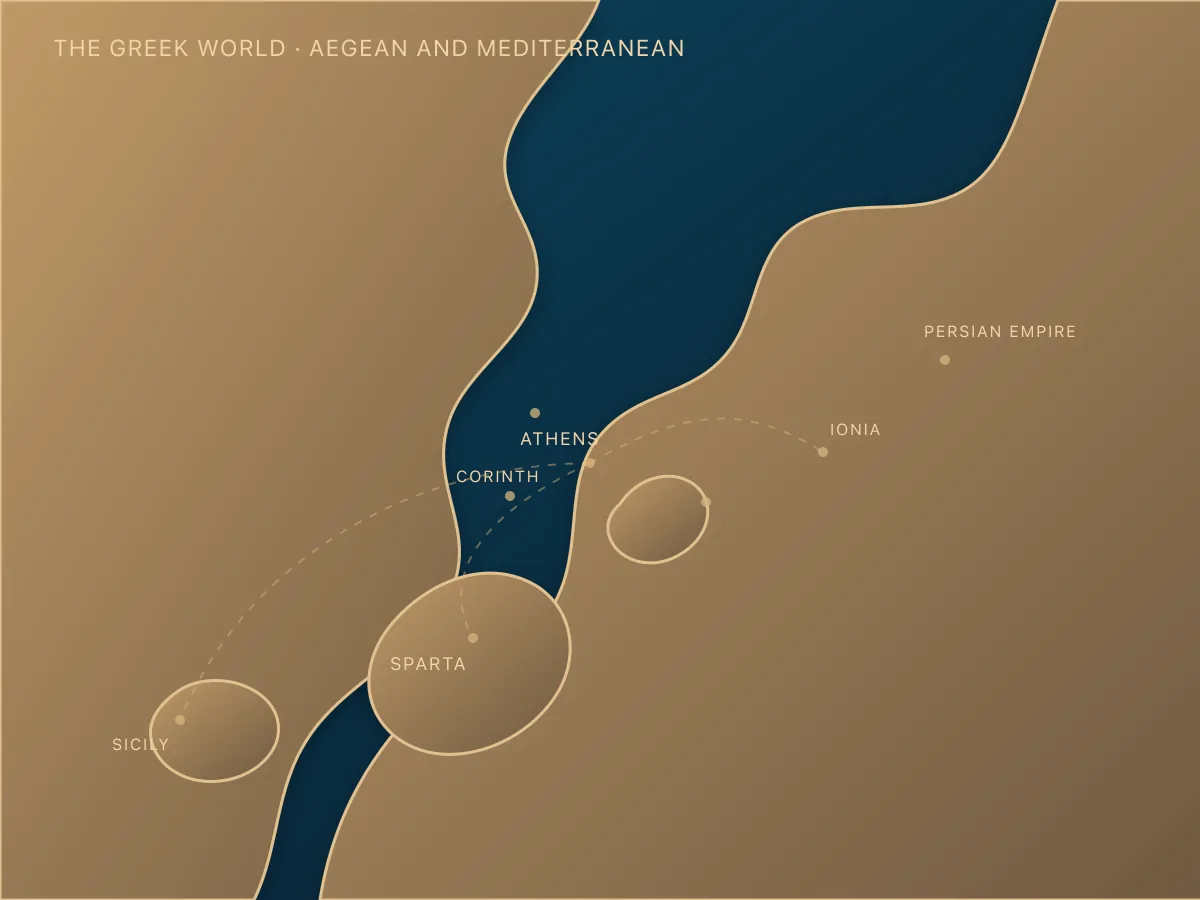
Nine dated map states move from invasion and walls through Sicily and Persian-funded sea war to oligarchic coercion and democratic return.

Athens

Walls, reserves and fleet

Sparta

Seasonal land invasion

Decisive changeNeither system can reach the other’s centre of power.

Sparta ravages Attica while Athens stays behind walls and strikes by sea.

Democratic exiles descend from Phyle as Spartan garrisons, Theban victory and later civic assemblies unfold across Greece.Place, date and surviving record

404–146 BCAthens · Sparta · Thebes · the Hellenistic world

Victory Puts Constitutions on Trial

Spartan hegemony, democratic return and later conquest made government a permanent object of comparison.

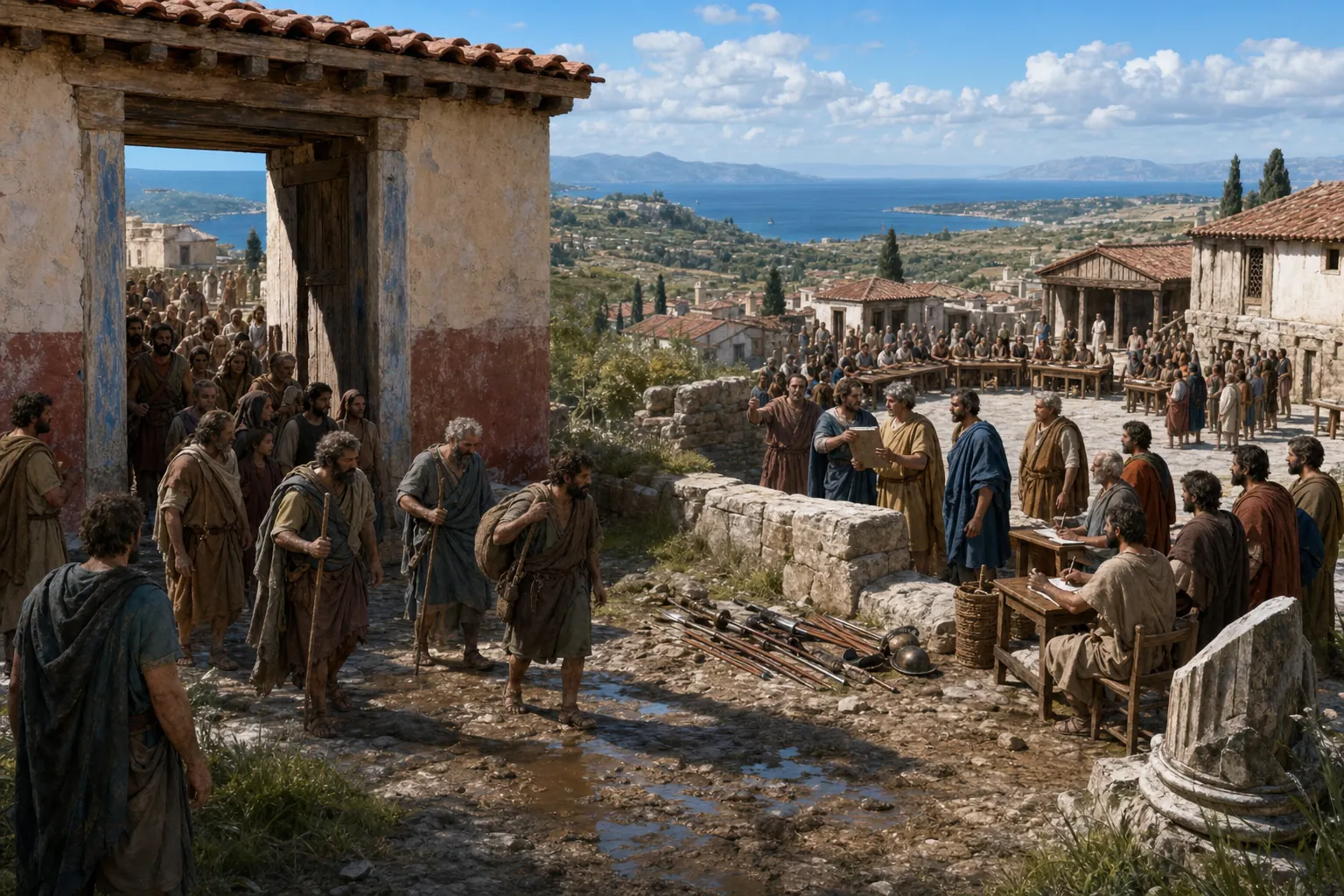
Democratic exiles descend from Phyle toward a city ruled by the Thirty. Civil fighting ends with restoration in 403 and an amnesty that restricts prosecution for acts committed under the oligarchy. The settlement cannot erase murder or dispossession. It makes continued public life possible by defining what the restored courts may reopen. A constitution proves able to return after military defeat, foreign pressure and internal terror.

Sparta now confronts the contradiction Athens had faced. It proclaims liberation, then places garrisons, military governors and friendly oligarchies in other cities. Partnership with Persia contributes to the King’s Peace, which presents the Great King as guarantor of Greek settlements. Thebes defeats Sparta at Leuctra in 371 and helps free Messenia, removing land and labour that had supported the full Spartan citizen body. Victory exposes limits hidden by earlier discipline.

Macedonian kings later dominate interstate war without abolishing the civic world. Cities negotiate privileges, honour benefactors, manage courts and send representatives into federal leagues. The Achaean League joins local citizenship to common councils, magistrates and armies across the Peloponnese. Scale changes, but public office remains the language through which communities organise themselves and bargain with stronger powers.

Writers turn this experience into sustained inquiry. Herodotus compares rule by one, few and many. Thucydides reconstructs decisions and civic breakdown; Xenophon follows defeat into new hegemonies. Plato and Aristotle ask how constitutions form citizens and decay. Assemblies, councils and democratic practices continue across many Hellenistic cities under kingdoms and leagues. When Rome destroys Corinth and defeats the Achaean League in 146, Greek civic government remains a living structure that conquest must use.

What survived
  • Xenophon records the surrender, rule of the Thirty and restoration while writing from his own political position.
  • Spartan garrisons, governors and settlements document the victor’s movement from liberation toward hegemony.
  • Inscriptions and civic institutions show active councils, assemblies and democratic practices across the Hellenistic period.

Xenophon (fourth century BC)Lynette Mitchell (2025)Matthew Simonton (2026)Paul Cartledge (2009)

Inscriptions · civic sites · ships · decrees · histories · constitutional argument

What survived

  1. G. S. KirkDark Age and Oral PoetProceedings of the Cambridge Philological Society 7, 1961
  2. Paul CartledgeAncient Greek Political Thought in PracticeCambridge University Press, 2009
  3. Michael GagarinWriting Greek LawCambridge University Press, 2008
  4. Josine BlokCitizenship in Classical AthensCambridge University Press, 2017
  5. M. G. L. Cooley, ed. and trans.SpartaCambridge University Press, 2023
  6. Alberto EsuDivided Power and Eunomia: Deliberative Procedures in Ancient SpartaThe Classical Quarterly 67, 2017
  7. Thomas ClementsHelots at Thermopylae: The Greek Dead at Herodotus 8.25The Classical Quarterly 74, 2024
  8. Matthew A. SearsSparta and the Commemoration of WarCambridge University Press, 2023
  9. David M. PritchardAthenian Democracy at WarCambridge University Press, 2018
  10. Matthew SimontonAncient Greek DemocraciesCambridge University Press, 2026
  11. Samuel Gartland and Robin Osborne, eds.Reassessing the Peloponnesian WarCambridge University Press, 2025
  12. Robin OsborneThe Causes of the Peloponnesian WarReassessing the Peloponnesian War, 2025
  13. Hans van WeesPeloponnesian War Aims and Strategies, 432–420Reassessing the Peloponnesian War, 2025
  14. Polly LowThe Athenian Empire and the Peloponnesian WarReassessing the Peloponnesian War, 2025
  15. Lynette MitchellGreek Constitutional Thinking and the Peloponnesian WarReassessing the Peloponnesian War, 2025
  16. Mogens Herman Hansen and Thomas Heine Nielsen, eds.An Inventory of Archaic and Classical PoleisOxford University Press, 2004
  17. HerodotusHistoriesPrimary ancient evidence, fifth century BC
  18. ThucydidesHistory of the Peloponnesian WarPrimary ancient evidence, late fifth century BC
  19. XenophonHellenicaPrimary ancient evidence, fourth century BC